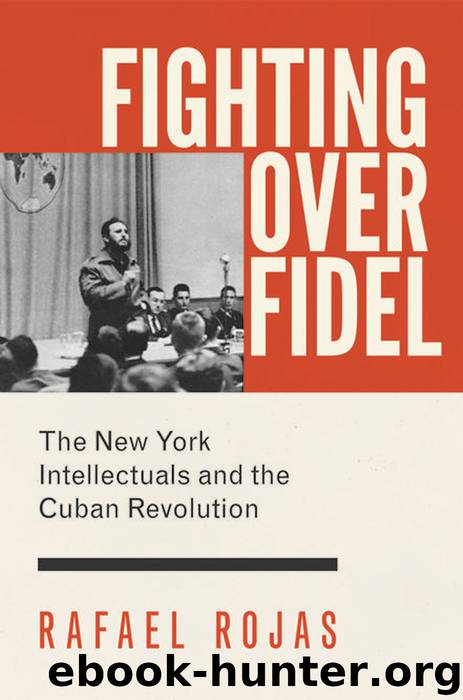
Fighting over Fidel by Rafael Rojas
Author:Rafael Rojas
Language: eng
Format: epub
Publisher: Princeton University Press
Published: 2015-04-09T04:00:00+00:00
6
NEGROES WITH GUNS
★
DURING THE 1960S, AS CUBA ADVANCED RAPIDLY TOWARD ITS socialist radicalization in the face of growing conflict with the United States, the American Left, for which the Cuban Revolution served as a key, albeit often uncomfortable, reference throughout the decade, was undergoing transformations of its own. In addition to the beat and hippie generations, the rise of the New Left was also manifested in the growth of the civil rights movement during this period, which was likewise linked from its beginnings with the Cuban process. Playing a key role in the civil rights struggle was the Black Panther Party, a political and military association led by such figures as Huey Newton, Bobby Seale, Little Bobby Hutton, Eldridge Cleaver, and H. Rap Brown. The Black Panthers, together with a number of prominent activists and intellectuals associated with the party, including Robert F. Williams, Stokely Carmichael, and Angela Davies, maintained strong ties with the Cuban Revolution throughout the 1960s, and several Black Panther leaders even spent periods of exile on the island.
Scholars such as Van Gosse and Mark Q. Sawyer have stressed the importance of the intersection between the African American Left’s rearticulation during this period and the discourse of solidarity with both Cuba and the decolonizing projects of Asia and Africa.1 Many black leaders became significantly engaged with the Third World struggle against colonialism, and their involvement with that struggle contributed decisively to the internationalization of the civil rights and black nationalist movements back in the United States. Thanks to this dialogue with decolonization, the intellectual discourse of the African American Left acquired a notable sophistication, which was then projected onto its own visions of the reality of Cuban socialism during the 1960s, particularly from 1963 to 1968, the five-year period during which Havana maintained its greatest distance from Moscow.
Like that of other New York leftist movements at the time, the Black Panthers’ relation to the Cuban Revolution was not without its disencounters, as has been demonstrated over the last several decades by scholars such as Ruth Reitan.2 The history of these disencounters is part of the plurality that characterized the American Left during the 1960s, and the tendency to undervalue or avoid this history is detrimental to the study of both American cultural politics of the 1960s and the diverse representations of Cuban socialism that it produced. In the pages that follow, I will propose a reconstruction of the intellectual dialogue between American black leaders and the Cuban Revolution and seek to capture two simultaneous images: that of Cuban socialism in the discourse of the African American Left and that of the Black Panthers in the Cuban public sphere. The conflicts between these two representations comprise one of the most interesting chapters of the intellectual history of the transamerican Left.
A rereading of these American black intellectuals’ writings on Cuba, including their occasional interventions in the island’s intellectual field itself, demonstrates the plurality of positions within the African American Left, which has so often been subjected to homogenizing historical frameworks in both the United States and Cuba.
Download
This site does not store any files on its server. We only index and link to content provided by other sites. Please contact the content providers to delete copyright contents if any and email us, we'll remove relevant links or contents immediately.
| Africa | Americas |
| Arctic & Antarctica | Asia |
| Australia & Oceania | Europe |
| Middle East | Russia |
| United States | World |
| Ancient Civilizations | Military |
| Historical Study & Educational Resources |
Cat's cradle by Kurt Vonnegut(15362)
Pimp by Iceberg Slim(14519)
4 3 2 1: A Novel by Paul Auster(12398)
Underground: A Human History of the Worlds Beneath Our Feet by Will Hunt(12100)
The Radium Girls by Kate Moore(12033)
Wiseguy by Nicholas Pileggi(5791)
The Fire Next Time by James Baldwin(5452)
Perfect Rhythm by Jae(5409)
American History Stories, Volume III (Yesterday's Classics) by Pratt Mara L(5310)
Paper Towns by Green John(5194)
Pale Blue Dot by Carl Sagan(5012)
A Higher Loyalty: Truth, Lies, and Leadership by James Comey(4965)
The Mayflower and the Pilgrims' New World by Nathaniel Philbrick(4506)
The Doomsday Machine by Daniel Ellsberg(4492)
Killers of the Flower Moon: The Osage Murders and the Birth of the FBI by David Grann(4449)
The Sympathizer by Viet Thanh Nguyen(4396)
Too Much and Not the Mood by Durga Chew-Bose(4349)
The Borden Murders by Sarah Miller(4329)
Sticky Fingers by Joe Hagan(4204)
